
Criminal Court Records in Pennington County
Pennington County criminal court records are created in Minnesota District Court when a citation, complaint, or other charging document opens a case. The local trial court is Pennington County District Court in the Ninth Judicial District, and court administration at the Pennington County Justice Center manages case files, copy requests, hearing questions, and certified court records. The District Court has original jurisdiction over criminal and traffic cases filed in the county, along with civil, family, probate, and juvenile matters. There is no separate county-level municipal or justice court identified for Pennington County case files.
The court record is the full case-level file. It can include the complaint or citation, probable-cause material that is public, bail or release conditions, hearing entries, plea documents, orders, warrants if public, disposition entries, sentencing terms, probation conditions, and public documents available online. A narrower charge record is covered separately on the arrest records and court charges page, while current custody information belongs with inmate records. For certified copies, older records, or items not posted online, the request path runs through District Court Administration rather than a private database.
The local prosecutor is the Pennington County Attorney. The County Attorney page explains that reports are made to the Sheriff's Office or Thief River Falls Police Department, law enforcement forwards proposed charges for review, and the prosecutor decides whether to draft a ticket or long-form complaint and file it with the court. The same source identifies charge levels used locally: petty misdemeanor, misdemeanor, gross misdemeanor, and felony. Petty misdemeanor is described as a maximum $300 fine and not a criminal charge, while felony matters can carry imprisonment over one year.
The Pennington County Attorney page is the source for the local charging office and its role in criminal case filing.
That office context matters because the court file begins only after charges are filed with District Court, even though the investigation and arrest record may begin with law enforcement.
How to Search Pennington County Criminal Court Records
Minnesota Court Records Online, usually called MCRO, is the main public search portal for Pennington County District Court criminal cases. MCRO Case Search allows searches by person name, business name, attorney name, case number, citation number, or attorney bar number. For a criminal search, select the Criminal category and use the county location filter for Pennington when you want local results only. MCRO provides case details, the Register of Actions, hearing information, and public documents when they are available online.
- Open MCRO Case Search and accept the access terms.
- Search by defendant name, case number, citation number, or attorney information.
- Select the Criminal case category and choose Pennington County if the search should be local.
- Open the case and review the Register of Actions, charges, hearings, disposition, and sentence entries.
- Request certified, exemplified, older, or unavailable copies from Pennington County District Court Administration.
MCRO online data is not a certified court record. Certified documents and certified judgment search results must come from court administration. Public courthouse terminals may also show records or documents that are not remotely available. For Pennington County, Court Administration is at 141 Main Ave S, Thief River Falls, MN 56701, phone 218-684-7000. Mail requests, in-person requests, and eFile and eServe copy requests are recognized channels in the Minnesota Judicial Branch copy process.
The daily Pennington court calendar can help confirm hearings. It shows party name, hearing location, hearing date and time, judicial officer, hearing type, connection type, and case number. Criminal examples in the research include 57-CR-26-172, and the citation guide explains that Minnesota case numbers contain a two-digit county number, case type letters, filing year, and sequence number. For Pennington, the observed county number is 57. CR indicates criminal cases with mandatory court appearance, while VB indicates non-mandatory violation-bureau cases.
Criminal Case Flow
A Pennington County criminal case commonly starts with a citation, complaint, arrest-related referral, or prosecutor-filed charging document. After filing, the case moves through appearances and hearings that appear as docket entries. The research calendar examples include first appearance, initial appearance - Rule 8, omnibus hearing, pretrial, probation violation hearing, review hearing, disposition hearing, and sentencing. Not every case includes every stage, and schedule changes should be checked with the calendar and court administration.
Case flow: Charges Filed › First Appearance or Rule 8 › Omnibus or Pretrial › Plea, Trial, or Dismissal › Disposition › Sentencing or Probation Review
| Stage | What Happens |
|---|---|
| Charging | The County Attorney files a ticket, complaint, or long-form charge with District Court after law-enforcement review. |
| First Appearance / Rule 8 | The defendant appears, rights and allegations are addressed, and release or bail conditions may be set. |
| Omnibus / Pretrial | The court handles evidentiary, procedural, negotiation, and scheduling issues before trial or plea. |
| Plea or Trial | The case may resolve by plea, proceed to trial, or have charges dismissed or amended. |
| Disposition | The court records the outcome for the case or for each count, such as guilty, dismissed, or acquitted. |
| Sentencing / Review | The court enters sentence terms, fines, probation conditions, and later review or probation-violation activity when applicable. |
The Pennington County Victim Services page documents local support during the criminal process.
Victim Services details are useful when reading a criminal docket because notifications, restitution, impact statements, and courtroom accompaniment can connect to hearings and sentencing events.
What a Pennington County Criminal Court Record Shows
A criminal court record should be read field by field, not as a single label. MCRO and the court calendar confirm core case information, Registers of Actions, hearings, hearing results, public documents, monetary details, and case numbers. Some information is redacted or withheld online, including party street addresses and comment fields in all case types. Criminal sentencing condition comments may display in MCRO. Public documents are generally more available online for major and minor criminal case types filed on or after July 1, 2015.
| Field | What It Shows |
|---|---|
| Case Number | The Minnesota court number, such as a 57-CR or 57-VB identifier for Pennington criminal or violation-bureau matters. |
| Case Caption | The party names and roles, usually State of Minnesota and the defendant. |
| Charges | The filed counts, severity level, statute or offense description, and later amendments or dismissals when entered. |
| Register of Actions | The chronological docket showing filings, hearings, notices, orders, warrants, and case events. |
| Hearings | Dates, times, judicial officer, hearing type, connection type, and results when available. |
| Plea | The defendant's formal response or plea agreement activity if publicly entered. |
| Disposition | The outcome of a charge or case, such as guilty, dismissed, acquitted, or other court-entered result. |
| Sentence | Jail, probation, fines, fees, conditions, restitution, or treatment terms when part of the public record. |
| Documents | Public filings and orders available online, with older and restricted documents requiring court administration review. |
Charges vs. Convictions
A charge is an accusation filed with the court. A conviction is an outcome that follows a guilty plea, guilty verdict, or other legally recognized adjudication. Pennington County criminal court records can show charges that were amended, reduced, dismissed, or resolved without conviction. That is why a court record should be read through the disposition and sentence fields rather than only the first charge line. The BCA public criminal-history search is separate from the District Court case file and does not replace the court docket.
| Charge | Conviction | |
|---|---|---|
| Stage | Filed accusation or count | Outcome after plea, verdict, or adjudication |
| Proof Level | Based on charging review and probable cause standards | Based on plea or proof beyond a reasonable doubt |
| Record Reading | Check amendments, dismissals, and charge status | Check disposition, sentence, and later expungement activity |
The Minnesota BCA public criminal-history search is a separate statewide criminal-history channel.
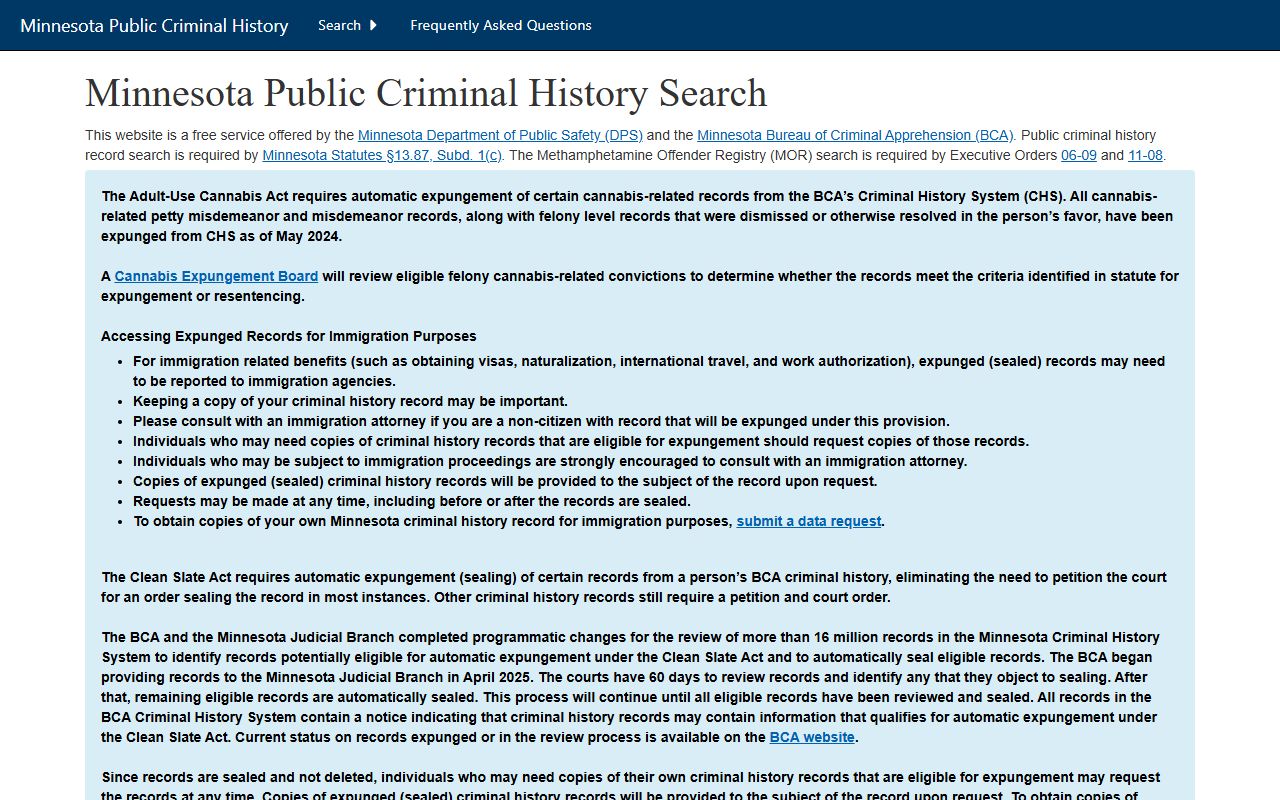
Use BCA history as a separate record source, then return to MCRO or District Court Administration for the underlying Pennington County case file and certified copies.
Sealed vs. Expunged Records
Sealing and expungement both limit ordinary public access, but Minnesota research for Pennington County points to specific expungement routes rather than a simple deletion rule. Petition-based criminal expungement uses Minn. Stat. Section 609A.03. The Pennington fee schedule lists criminal expungement at $320, with possible waivers in qualifying cases or for indigency. Clean Slate automatic expungement is addressed by Minn. Stat. Section 609A.015 and related laws. A court entry may show BCA Automatic Expungement Notice, but that does not mean every case is automatically sealed.
| Sealed | Expunged | |
|---|---|---|
| Visibility | Removed from ordinary public view by rule, statute, or order | Sealed from public view through a statutory expungement process or automatic process |
| Access | May require party status, court order, or statutory exception | May still have agency exceptions depending on the order or statute |
| Pennington Path | Contact District Court Administration for access questions | Use Minnesota expungement statutes and District Court procedures unless automatic Clean Slate applies |
The petition process is grounded in Minn. Stat. Section 609A.03.
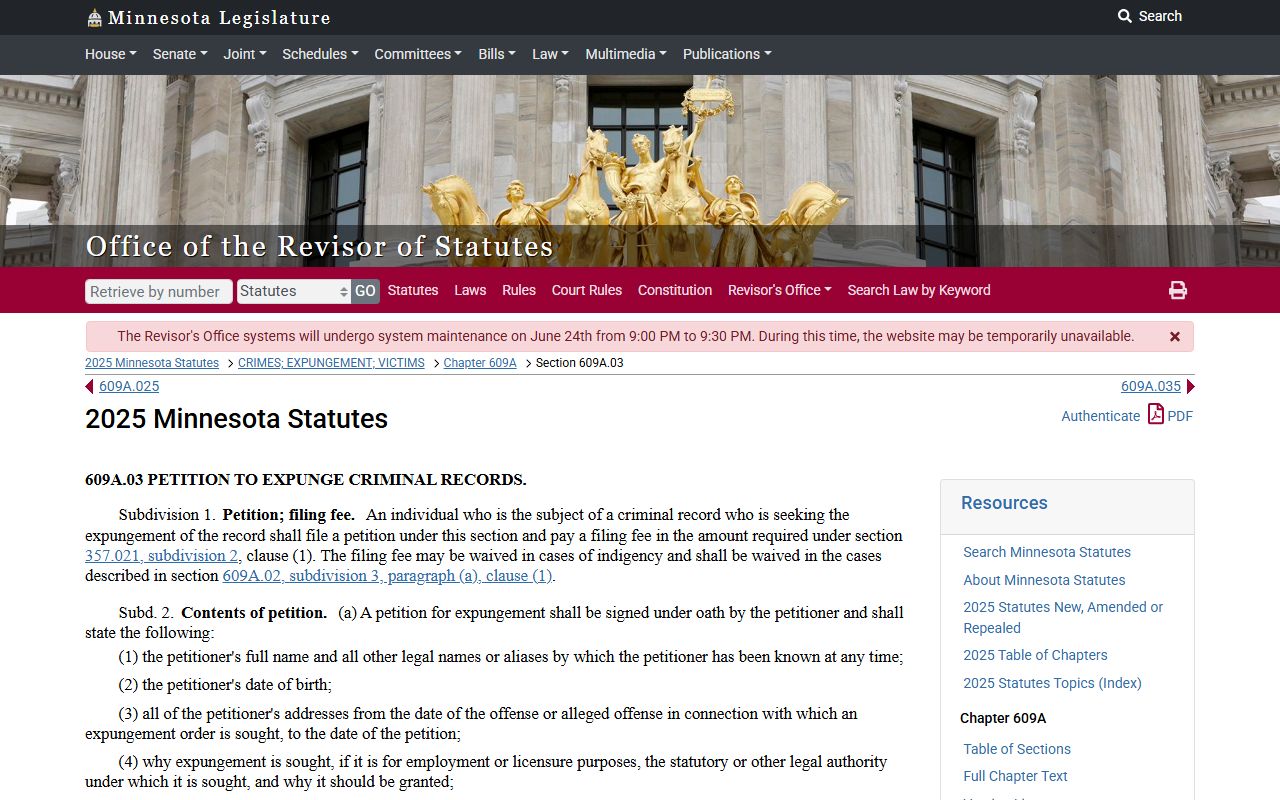
Petition-based expungement is not instant because service, hearing timing, judicial review, and post-order waiting periods can affect when public visibility changes.
Clean Slate automatic expungement is addressed in Minn. Stat. Section 609A.015.
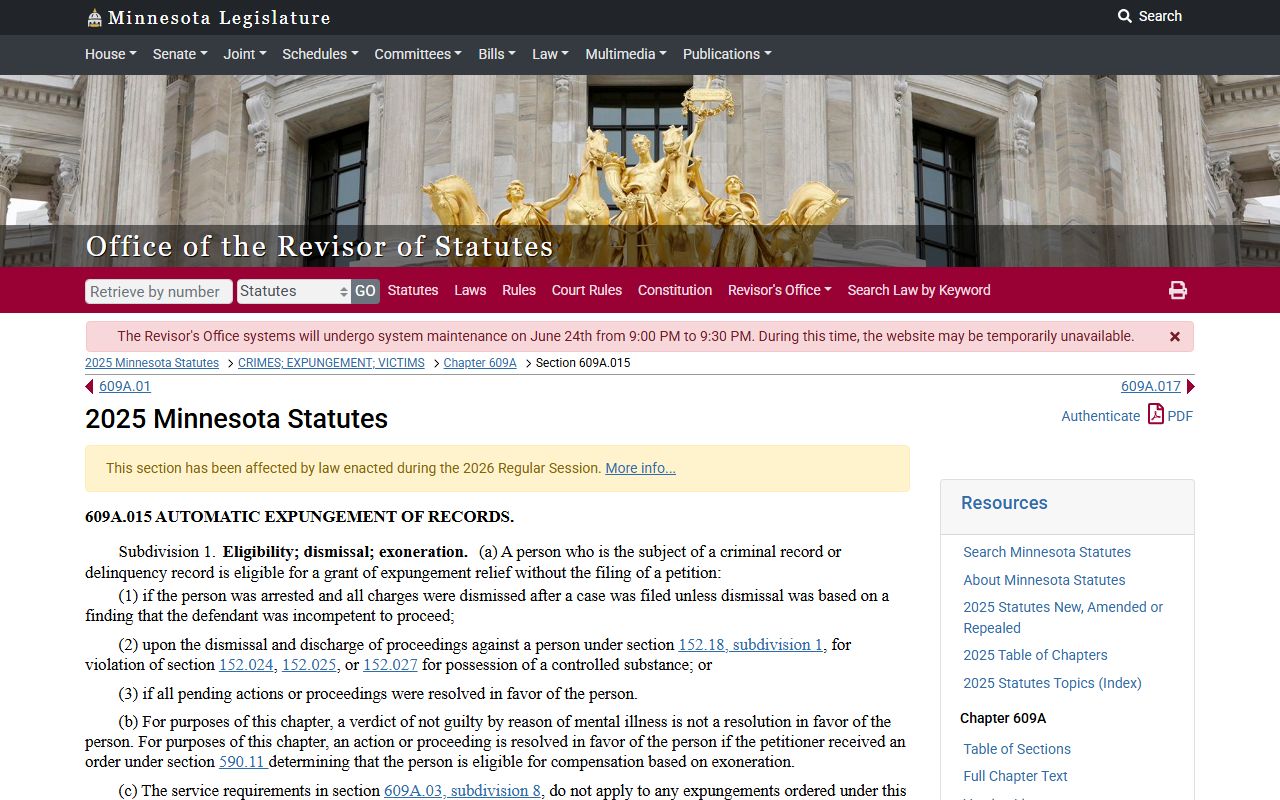
Automatic expungement can affect qualifying criminal and juvenile records, but case-specific eligibility still needs to be checked against the court record and official agency notices.
Public Access to Criminal Court Records
Minnesota's Government Data Practices Act, law-enforcement data statute, criminal-history statute, and Judicial Branch public-access rules all shape what a user can see. The plain rule for Pennington County is that public District Court criminal records are searchable, but remote online access is narrower than courthouse access. Juvenile delinquency felony 16 case types, child protection, domestic abuse order-for-protection, harassment restraining order, civil commitment, sealed, and expunged records have special restrictions. Ongoing investigations and protected law-enforcement data may also be withheld.
Key Statutes:
Minn. Stat. Chapter 13 governs public access to Minnesota government data unless law classifies data otherwise.
Minn. Stat. Section 13.82 covers law-enforcement data, including public and restricted arrest or investigative information.
Minn. Stat. Section 13.87 governs criminal-history data dissemination.
The criminal-history data statute is published at Minn. Stat. Section 13.87.
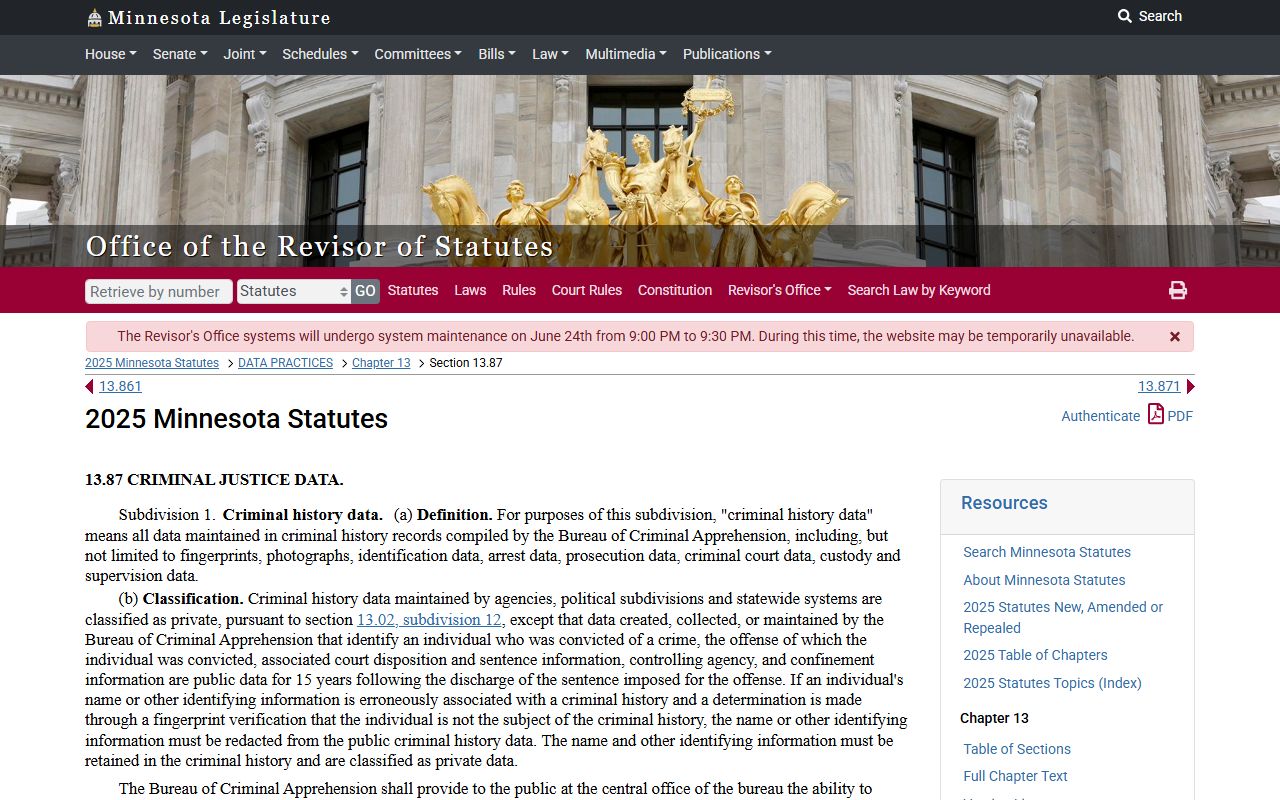
This statute helps explain why a statewide criminal-history result and a Pennington County District Court file are related but not identical records.
Background Check Considerations
Casual court lookup is not the same as an employment, tenant, credit, insurance, or licensing background check. Public MCRO records, BCA records, jail records, and warrant listings can update at different times and use different legal definitions. A charge may not be a conviction, an arrest may not produce a court case, and a court disposition may not appear the same way in a criminal-history product. For official uses, request certified court copies from District Court Administration and use a legally compliant background-check process.
Important: This website is not a consumer reporting agency and cannot be used for FCRA-regulated screening decisions.
Restricted Criminal Court Records in Pennington County
Some records are not available through a normal Pennington County criminal court search. Juvenile records, sealed matters, expunged cases, domestic abuse and harassment case types, civil commitment matters, and protected personal identifiers can be restricted by court rule, statute, or court order. MCRO also limits online document availability for older filings. When a case exists but the needed document is not remote, contact Court Administration at the Justice Center or use the Judicial Branch copy process. When the question involves arrest or investigative data rather than court filings, the Sheriff's Office is the correct public-data starting point.